
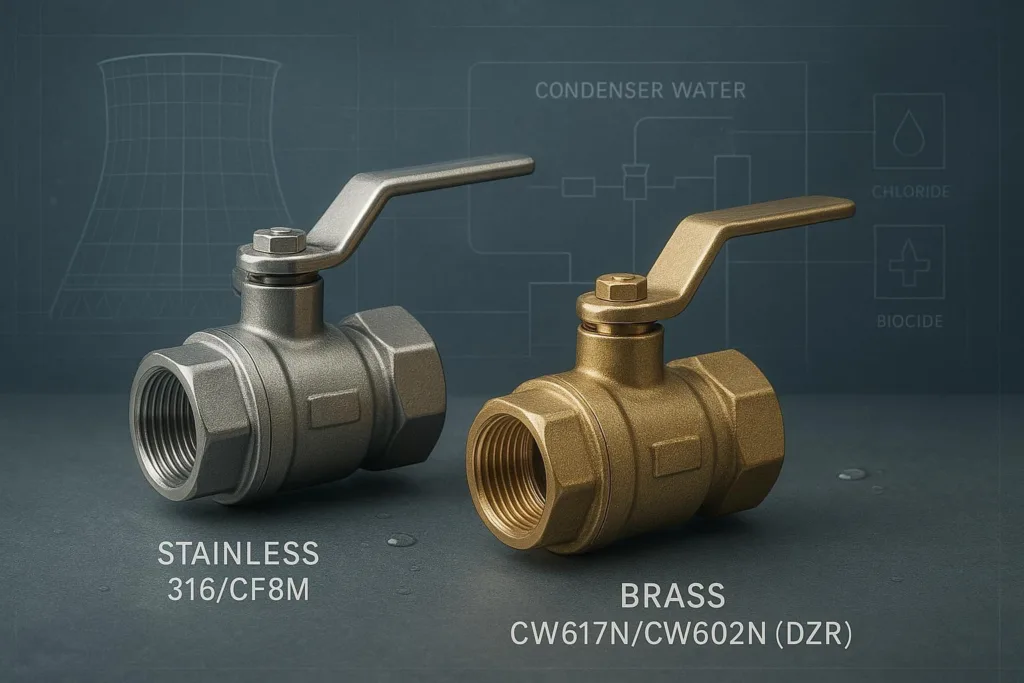
Open condenser water and cooling tower loops are unforgiving. Chlorides concentrate, oxidizing biocides run routinely, and deposits create tight crevices. If you have to make one material decision that protects uptime, it’s this: for most open-tower duty, 316 stainless steel ball valves are the safer default. DZR brass can work, but only when water chemistry is tightly controlled and the valve is used as shutoff with documented dezincification resistance.
Key takeaways
- The single decision driver is resistance to chlorides and oxidizing biocides in an open loop. Type 316 stainless outperforms 304 and brass in pitting and crevice corrosion under these conditions, per the Nickel Institute’s guidance for naturally occurring waters, which favors 316 when chlorides rise above roughly 200 ppm and crevice conditions exist. See the detailed discussion in the Nickel Institute’s water corrosion paper linked below.
- Standard brass (CW617N) is prone to dezincification and, under some chemistries, stress corrosion cracking. DZR brass (CW602N) is engineered to resist dezincification and should be accepted only with ISO 6509 documentation and a disciplined treatment program.
- Seats and packing often fail before metal bodies in tower duty; PTFE or RTFE seats are broadly compatible with chlorine and bromine programs and are generally preferred.
- Compliance matters for audits and approval cycles. Map selections to ASME B16.34 and API 608 for industrial duty, and to NSF/ANSI 61 and 372 or BS EN 13828 when there’s a potable-water crossover.
- Pricing diverges. Stainless costs more upfront, but in high-chloride tower service it frequently reduces unplanned maintenance and lifecycle risk compared with brass.
Stainless steel vs brass ball valve: why the choice isn’t close in open towers
When the operating environment concentrates chlorides and uses oxidizing biocides, the stainless steel vs brass ball valve decision leans decisively toward 316. The Nickel Institute’s technical literature on stainless steels in water service explains why 316’s higher resistance to pitting and crevice corrosion provides a wider safety margin than 304 as chlorides climb and temperatures rise. Brass, meanwhile, brings a separate failure mode—dezincification—that accelerates leakage once it starts, unless DZR chemistry and tight water control are proven.
Stainless steel vs brass ball valve for cooling towers — side‑by‑side comparison
Two families of alloys and two very different corrosion stories. The table keeps fields symmetrical so engineering and procurement can compare like for like.
| Dimension | Stainless 304 (CF8) | Stainless 316 (CF8M) | Brass CW617N | DZR Brass CW602N |
|---|---|---|---|---|
| Material designation | Cast austenitic stainless per ASTM A351 CF8 | Cast austenitic stainless per ASTM A351 CF8M | Copper alloy per EN 12165/12164 | DZR copper alloy per EN 12165/12164 |
| Chloride and biocide resistance | Adequate only at lower chlorides and mild conditions; higher pitting risk in crevices | Superior pitting and crevice resistance; preferred where chlorides rise and biocides are used | Susceptible to dezincification in chloride and oxidizing environments | Formulated to resist dezincification; still chemistry‑dependent |
| Dezincification or SCC risk | Not applicable in the same mechanism | Not applicable in the same mechanism | Elevated risk of dezincification and occasional SCC under ammonia or chloramines | Greatly reduced dezincification versus CW617N when validated to ISO 6509 |
| Pressure–temperature envelope | Governed by valve design to ASME B16.34 classes; verify seat‑limited ratings in datasheets | Same as 304; 316 body offers corrosion margin rather than higher class | Typically WOG/CWP ratings set by OEM; often lower temperature ceilings | Similar to CW617N; check WOG/CWP and seat limits per OEM |
| Seat and seal compatibility | PTFE/RTFE recommended in oxidizing biocide programs | PTFE/RTFE recommended in oxidizing biocide programs | PTFE/RTFE recommended; avoid elastomers incompatible with oxidants | PTFE/RTFE recommended; same cautions as CW617N |
| Compliance alignment | Industrial duty per API 608 and ASME B16.34 markings common | Same; also available with fire testing where applicable | Building water valves often reference BS EN 13828; potable service requires NSF/ANSI 61 and 372 where applicable | Same as CW617N, with dezincification resistance expectation |
| Maintenance profile in towers | Lower likelihood of body/ball corrosion; inspect for seat wear and crevice deposits | Lowest corrosion risk in this set; focus maintenance on seats and deposits | Monitor for red, porous dezincified surfaces and leakage; shorten inspection intervals | Acceptable with proof of DZR, but keep inspections; chemistry drift can still attack |
| Availability and lead time | Broadly available in threaded and flanged 1–4 inch; some sizes made‑to‑order | Widely stocked in 1–2 inch; larger sizes may carry longer lead times | Very widely available and low cost; short lead times typical | Common in plumbing/HVAC channels; lead times modest |
| Pricing snapshot 2026 (1–4 in) | Higher upfront than brass | Highest upfront in set | Lowest upfront | Slight premium over standard brass |
| Best for | Closed loops or mild open towers with verified low chlorides | Open towers with variable or high chlorides and oxidizing biocides | Budget‑constrained shutoff in controlled, low‑chloride service | Budget retrofit with documented chemistry control and ISO 6509 proof |
Notes on evidence and scope
- Stainless chloride guidance and the 304 vs 316 preference in elevated chlorides are drawn from the Nickel Institute’s technical papers on stainless steels in water service, which explain why 316 has higher critical pitting temperature and is favored when chlorides and crevices coexist. See the detailed water guidance in the Nickel Institute paper Resistance of Stainless Steels to Corrosion in Naturally Occurring Waters.
- Dezincification risk and DZR mitigation follow ISO 6509 test definitions; acceptance should rely on documented testing to that method.
- Pressure–temperature envelopes reference ASME B16.34 classes and seat‑limited OEM charts; always verify on the actual datasheet for the selected valve.
- Potable‑contact selections should be cross‑checked for NSF/ANSI 61 and 372 or BS EN 13828 applicability.
Key references linked below provide the primary technical rationale.
How to choose for an open condenser water loop
Here’s the decision logic buyers and engineers can stand behind. If your circulating chlorides or excursions can push you into pitting territory, pick stainless 316. The Nickel Institute’s guidance for naturally occurring waters indicates Type 304 becomes marginal as chlorides rise and crevices tighten, while 316 is the preferred grade under those conditions due to its higher resistance to pitting and crevice attack. When tower chemistry is tightly controlled and independently verified, DZR brass can be considered for shutoff‑only duty with a clear dezincification test record.
- Chloride threshold and excursions: Use 316 when steady‑state or excursion chlorides approach levels that promote pitting, and when oxidizing biocides are part of routine treatment. Remember that cooling towers concentrate salts by cycles of concentration; even low‑chloride makeup can produce much higher circulating levels during peaks, which is why operators track and control cycles deliberately.
- Duty and risk posture: For throttling, frequent cycling, or where downtime is expensive, prioritize 316. For shutoff‑only duty in budget‑limited retrofits with demonstrably low chlorides and strong inhibitor programs, DZR brass is a defensible compromise with monitoring.
- Potable crossover: Any potential tie‑in to potable systems pushes you to NSF/ANSI 61 and 372 or BS EN 13828 compliance. Stainless inherently avoids lead content concerns; low‑lead brass must prove compliance through certification.
- Welding and thermal cleaning: Where welding is required or aggressive chemical cleans occur, choose low‑carbon 316L variants to mitigate sensitization and maintain corrosion resistance.
Maintenance and risk controls for towers
Open towers demand disciplined inspections. On stainless 316, focus on deposit control and seat condition rather than body corrosion; remove scale and biofilm that create crevices, and verify that biocide residuals stay within program targets. On brass, train technicians to recognize early signs of dezincification—reddish, porous surfaces; weeping around joints; chalky residues—then escalate to replacement, because metal loss accelerates. Avoid mixed‑metallurgy traps: stainless attached to large brass runs makes brass the anode in tower electrolytes, and localized corrosion accelerates. Where mixing is unavoidable, use dielectric unions, keep area ratios reasonable, and maintain inhibitors. For soft parts, PTFE or RTFE seats tolerate halogen oxidizers well, but confirm compatibility and temperature limits on the chosen datasheet.
Pricing snapshot as of 2026‑03‑25
Representative public‑market ranges for industrial and HVAC ball valves in the US, 1–4 inch, compiled from 2024–2026 distributor listings and catalogs. Actual pricing varies by porting, end connections, pressure class, certifications, region, and volume. As a planning guide: Brass CW617N roughly 1 in $15–45, 2 in $35–95, 3 in $80–180, 4 in $150–350; DZR brass CW602N roughly 1 in $20–55, 2 in $45–120, 3 in $100–220, 4 in $180–420; Stainless 304/316 roughly 1 in $40–120, 2 in $90–250, 3 in $200–500, 4 in $350–900+. Treat pricing as volatile and verify during RFQ to match your exact spec and delivery window.
Procurement QA dossier checklist
Speed up approvals by requesting complete documentation up front: certified MTRs for ASTM A351 CF8/CF8M or EN 12165 alloys; valve marking photos showing API 608 and ASME B16.34 where applicable; API 598 hydrostatic and seat leakage test reports; ISO 9001 certificate and any CE declaration of conformity; seat and packing material specifications with chemical compatibility notes; and a traceability matrix linking heat numbers to valve serials.
Best for scenarios
| Scenario | Recommended material | Rationale |
|---|---|---|
| Open tower with variable or high chlorides and oxidizing biocides | Stainless 316 CF8M | Highest margin against pitting and crevice attack in chloride and biocide exposure; robust to excursions |
| Budget retrofit with verified low chlorides and strong inhibitor program | DZR brass CW602N | Documented dezincification resistance per ISO 6509 and acceptable for shutoff duty with monitoring |
| Potential potable crossover or mixed service | Stainless or certified low‑lead brass | Simplifies NSF/ANSI 61 and 372 compliance; stainless avoids lead content entirely |
| Welding required or aggressive chemical cleans | 316L variants | Low‑carbon grades reduce sensitization risk and maintain corrosion resistance |
FAQ
What chloride level tips the choice to stainless 316 over brass for cooling towers
- The conservative rule of thumb is to select 316 once chloride levels and crevice conditions make 304 marginal. The Nickel Institute’s technical literature on stainless steels in water service explains why 316 resists pitting and crevice corrosion better than 304 as chlorides climb and temperatures rise. In open towers, cycles of concentration can push circulating chlorides well above makeup; operators manage cycles specifically to keep salts in check, but excursions happen.
Can DZR brass be used in open condenser water loops
- Yes, with caveats. Choose DZR brass (CW602N) only with evidence of dezincification resistance per ISO 6509 and only when your water treatment program reliably holds chemistry within target bands. Increase inspection frequency and be prepared to replace at the first signs of porous, red dezincified metal because progression accelerates once it begins.
What are early signs of dezincification in brass valves
- Reddish, porous‑looking surfaces where zinc has leached out, chalky residues, and leaks or weeping at joints. If you see these in tower duty, plan a changeout and review inhibitors and oxidant residuals.
Is 304 stainless acceptable in cooling towers
- Sometimes, under lower chloride loading with excellent deposit control and mild temperatures. However, 304 has a lower critical pitting temperature and narrower margin against crevice corrosion. That’s why many engineers specify 316 as the default for open towers with routine oxidizing biocide programs.
How do potable water requirements affect the choice
- Any potable crossover brings NSF/ANSI 61 and 372 or BS EN 13828 into scope. Stainless inherently meets low‑lead expectations, while brass must be specifically certified to these standards for potable contact.
References and further reading
- Stainless steel grade selection for chloride waters and crevice conditions is well summarized in the Nickel Institute’s technical paper Resistance of Stainless Steels to Corrosion in Naturally Occurring Waters: https://nickelinstitute.org/media/8d91ba682b1c1d5/ni_inco_1262_resistanceofstainlesssteeltocorrosioninnaturallyoccurringwaters.pdf
- Dezincification testing method and acceptance for DZR brass are defined in ISO 6509; see an accessible overview of the test method here: https://cdn.standards.iteh.ai/samples/59999/93e589f92ea549829c86322bc02dc02e/ISO-6509-1-2014.pdf
- Pressure–temperature rating concepts and materials groupings for metal valves are consolidated in this overview of ASME B16.34: https://blog.projectmaterials.com/valves/asme-b16-34-valve-specification/
- Potable water certification scope is outlined in NSF’s knowledge page on Safe Drinking Water Act requirements and NSF/ANSI 61 and 372: https://www.nsf.org/knowledge-library/safe-drinking-water-act-requirements
- Galvanic corrosion management and area‑ratio effects for dissimilar metals are discussed in this Nickel Institute guide: https://nickelinstitute.org/media/1721/managinggalvaniccorrosion_14027_.pdf
Final word for specifiers and buyers
If your open tower loop sees routine oxidizing biocides and any chance of chloride excursions, stainless steel vs brass ball valve isn’t a toss‑up—316 stainless is the conservative, standards‑aligned choice with a wider safety margin. Where budgets force compromises and chemistry is tightly held, DZR brass can be justified for shutoff duty, but only with ISO 6509 documentation and elevated inspections. Think of it this way: pay more once for margin against pitting and crevice corrosion, or pay later in downtime and replacements. Align the selection with ASME B16.34 or BS EN 13828 and the right NSF standards, verify seat compatibility, and document everything in your QA pack.